Download PDF Liberation And Reconciliation: A Black Theology, Second Edition, by J. Deotis Roberts
Success can be begun by process. One of procedures that are really urgent as well as important is by reviewing books. Why should read? Reading becomes one the simplest methods to get to the expertise, to improve the experiment, and to get the inspirations openly. The book that should be read are additionally different. But, it will certainly depend on the instances that relate to you.
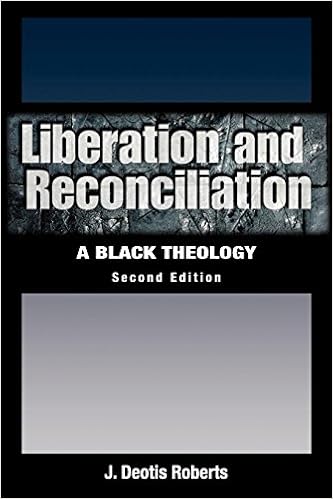
Liberation And Reconciliation: A Black Theology, Second Edition, by J. Deotis Roberts

Download PDF Liberation And Reconciliation: A Black Theology, Second Edition, by J. Deotis Roberts
Make use of the advanced innovation that human develops today to locate guide Liberation And Reconciliation: A Black Theology, Second Edition, By J. Deotis Roberts effortlessly. However first, we will certainly ask you, how much do you enjoy to review a book Liberation And Reconciliation: A Black Theology, Second Edition, By J. Deotis Roberts Does it always until finish? Wherefore does that book check out? Well, if you truly like reading, aim to check out the Liberation And Reconciliation: A Black Theology, Second Edition, By J. Deotis Roberts as one of your reading compilation. If you just read guide based upon need at the time as well as unfinished, you need to attempt to such as reading Liberation And Reconciliation: A Black Theology, Second Edition, By J. Deotis Roberts first.
When having ideas to be extra successful as well as much better individual, one to constantly be reminded is about just how the procedure you will gain. Reading publication is really one process that will certainly support you getting the ideas from lots of resources. Also it includes whatever basic to complicated; book will certainly accompany you to constantly add lesson as well as experience. Liberation And Reconciliation: A Black Theology, Second Edition, By J. Deotis Roberts as one to refer is also among the books that has wonderful advances. Yeah, every publication always has own advances.
This book will certainly show you the recent publication that can be obtained in some places. However, the inspiring publication will be far more developed. But this Liberation And Reconciliation: A Black Theology, Second Edition, By J. Deotis Roberts, it will reveal you recent thing that you need to know. Checking out publication as one of the tasks in your vacations is very wise. Not everybody will certainly have ready to do it. So, when you are individual that enjoy this publication to check out, you should enjoy the moment analysis as well as completing this publication.
Obtaining the soft data of this book can be very easy done. Just by clicking the link, you can link to the book soft documents as well as start to get it. When you have actually conserved Liberation And Reconciliation: A Black Theology, Second Edition, By J. Deotis Roberts in your gadget, you could earlier begin reading. See from the title of this book, it can be picked and described just how this book is presented. They are really well done and so excellent to check out accompanying your free time.
An expansion of the 1971 classic text, this second edition of Liberation and Reconciliation argues for a balance between the quest for liberation and the need for reconciliation in black-white relations. Written by one of the pioneers of Black Theology, it examines biblical and theological themes from the perspective of Black experience and concludes that nonviolent reconciliation is the best response to racial oppression.
Product details
Paperback: 120 pages
Publisher: Westminster John Knox Press; 2 edition (May 27, 2005)
Language: English
ISBN-10: 0664229654
ISBN-13: 978-0664229658
Product Dimensions:
6 x 0.3 x 9 inches
Shipping Weight: 7.2 ounces (View shipping rates and policies)
Average Customer Review:
5.0 out of 5 stars
3 customer reviews
Amazon Best Sellers Rank:
#186,227 in Books (See Top 100 in Books)
Great book for classrooms.
At the time this book was published in 1971, J. Deotis Roberts was a professor of theology at Howard University; he has also written other books such as Black Religion, Black Theology: The Collected Essays of J. Deotis Roberts (African American Religious Thought and Life),Bonhoeffer and King: Speaking Truth to Power,The Prophethood of Black Believers: An African American Political Theology for Ministry etc. [NOTE: page numbers below refer to the original 205-page paperback edition.]He wrote in the Preface of this 1971 book, “The present volume is an introduction to soul theology. 'Soul' sums up the black experience, whether religious or secular, better than any other term. Here we have attempted a Christian theological interpretation of the soul religious experience as we understand it as a Christian and as a theologian whose face is black. Soul theology is Black Theology… In the following pages much will be said about ‘black liberation.’ We are aware of the gospel of freedom to which Christ as Liberator has called us. But, as Christians, black and white, we surely know that separation, however rewarding to set the record straight, CANNOT be an ultimate Christian goal. Separation must give way to RECONCILIATION. The gospel is a reconciling as well as a liberating gospel and Christ is at once Liberator and Reconciler. At the same time that black Christians are set free they are called together with all other Christians to a ministry of reconciliation.“Reconciliation, between blacks and whites, is a two-way street. It depends as much upon what whites WILL DO to make conditions in race relations better as it does upon what blacks WILL NOT DO… Reconciliation must be based upon a oneness in nature and grace between all people upon the principle of equity. EQUALITY belongs to the time of integration. It assumes that blacks must earn the right to be equal---to be accepted into the American mainstream. Equity, on the other hand, belongs to the time of Black Power, black pride, awareness, and self-determination. Equity assumes that all men are naturally equal. Human dignity is a birthright. Black Theology affirms this and goes on to root equity, as the only principle of black-white reconciliation, in the Christian understanding of creation and redemption.â€He begins the book by stating, "It is my view that liberation and reconciliation must be considered at the same time and in relation to each other. The all-or-nothing, victory-or-death approach to race relations appears to be more rhetoric than reality, even to those who hold it. The same may be said concerning the ‘black’ or ‘white’ conception of ethics. In the long run, ‘gray’ is more honest and realistic.†(Pg. 13-14) He adds, "Can there be a constructive interpretation of this new militancy which can be reinterpreted and even sponsored by the Christian faith with its revolutionary message? It is the opinion of this author that the latter is possible and that this is the proper mission of a Black Theology." (Pg. 17)He notes that “Those of us who have black skin and who are conscious of our blackness, but who have passed through various stages of racial protest, face a problem of ‘internal communication’ with young, angry, militant black youth who have just discovered what it means to be black in a white racist society… Many blacks who are not Christians are associated with ‘the religion of Black Power.’ A black theologian who operates from the Christian faith has difficulty being heard in this company, however angry he may be… The present writer takes his stand within the Christian theological circle.†(Pg. 21)He continues, “A Christian theologian is not an interpreter of the religion of Black Power. He, as black theologian, may be the interpreter of Afro-American Christianity… But he is attempting to understand the Christian faith in the light of his people’s experience… His theological task is a type of ministry to blacks and whites. It is a priestly ministry to blacks… The black theologian’s role is that of a prophet as well. His message will often be unwelcomed by blacks as well as by whites. But… he will need to speak of reconciliation beyond confrontation and liberation whatever the risk and whatever the personal cost.†(Pg. 21-22) He adds, “It is the goal of a worthy Black Theology to lead both blacks and whites to an authentic Christian existence… Authentic existence for blacks and whites can only be realized finally in reconciliation between equals in the body of Christ.†(Pg. 24-25)He explains, “Liberation is revolutionary---for blacks it points to what ought to be. Black Christians desire radical and rapid social change in America as a matter of survival. Black Christian faith is avowedly revolutionary and, therefore, it may speak to this need with great force.†(Pg. 27)He observes, “Many blacks are turned off by the idea that their suffering as a people may have some purpose… Whenever someone makes the suggestion that perhaps the clue to the black man’s chosenness is his suffering, my mind raises real question. The crucial question is representative. Is it necessary that such oppression and undeserved suffering continue in order that grace may abound? My suspicion is aroused further by the fact that the affirmative attitude toward human suffering comes from the side of the oppressor and not from the oppressed themselves. This leads me to suggest that whatever understanding of our chosenness emerges in a Black Theology must take under serious account the fact that the black man’s experience has been purged in the fires of suffering. But our interpretation of chosenness must at the same time hold up the promise of a better day. The uses of our past must be for the redemption of our future.†(Pg. 52-53)Later, he notes, "The God of Moses, the God of the exodus, has been real to black people. This God is one of deliverance from bondage. The God who assures the Israelites constantly, 'as I was with Moses, even so I will be with thee' has comforted, strengthened, and brought great assurance to black Christians throughout all their years of oppression in this country. Thus the God of the exodus is the black man's God." (Pg. 99)He acknowledges, “It appears to me that that black theologian has much to learn from existentialism as he seeks to develop a helpful understanding of human nature. When I refer to this self-reflective movement, I do not particularly have in mind nihilism or pessimism; neither do I cherish its preoccupation with the absurd, with death, or with rebellion. It is not the posture of existentialists who confront life WITHOUT GOD, but those who are conscious that man stands BEFORE GOD that is most attractive for the formulation of a Christian anthropology.†(Pg. 106)He clarifies, “The black Messiah encounters the black Christian on the level of personal experience in the black church in its setting in the black community enabling black Christians to overcome their identity crisis---having been alienated, despised, and rejected by the larger community and even in so-called integrated congregations. I do not take the figure of a black Messiah in literal historical sense. It is rather the symbol or a myth with profound meaning for black people. It is, therefore, necessary to give some attention to what we mean by a symbol or a myth.†(Pg. 130) Later, he adds, “Since the black experience has been disregarded in other versions of Christology, there is a need to make Christ and his message speak directly to the black man.†(Pg. 136)He states, “The black Christ participates in the black experience. In some sense Christ makes contact with what the black Christian is aware of in his unique history and personal experience. He ENCOUNTERS Christ IN that experience and is CONFRONTED by the claims of Christ also in his black experience. But at the same time, the confrontation of the black Christian with the black Messiah, who is also the UNIVERSAL Christ, points him beyond the mere symbolism is rooted in his experience. In other words, the universal Christ is particularized for the black Christian in the black experience of the black messiah, but the black Messiah is at the same time universalized in the Christ of the Gospels who meets all men in their situation. The black messiah liberates the black man. The universal Christ RECONCILES the black man with the rest of mankind.†(Pg. 139-140)He concludes, “Blacks must not allow whites to salve their consciences through reparations. Too many whites are pleased to be rid of the black presence by funding some empowerment project in the black community. They are Christian colonizers who will use separatism to strengthen their racist program. Blacks in white churches must be ‘plagues on the houses’ of white racists who desire to be at ease in Zion while racial injustices continue. Our quest for a theological ethic must provide the ethical imperatives that will lead the church, black and white, to be the church---a liberating and reconciling church.†(Pg. 198)This book, though nearly fifty years old, remains of great interest to contemporary students of theology.
At the time this book was published in 1971, J. Deotis Roberts was a professor of theology at Howard University; he has also written other books such as Bonhoeffer and King: Speaking Truth to Power,Black Religion, Black Theology: The Collected Essays of J. Deotis Roberts (African American Religious Thought and Life), etc.He wrote in the Preface, "The present volume is an introduction to soul theology. 'Soul' sums up the black experience, whether religious or secular, better than any other term. Here we have attempted a Christian theological interpretation of the soul religious experience as we understand it as a Christian and as a theologian whose face is black. Soul theology is Black Theology."He begins the book by stating, "It is my view that liberation and reconciliation must be considered at the same time and in relation to each other. The all-or-nothing, victory-or-death approach to race relations appears to be more rhetoric than reality, even to those who hold it." (Pg. 13-14) He adds, "Can there be a constructive interpretation of this new militancy which can be reinterpreted and even sponsored by the Christian faith with its revolutionary message? It is the opinion of this author that the latter is possible and that this is the proper mission of a Black Theology." (Pg. 17)He suggests that Vincent Harding advocates a "Black Power religion," while James Cone "is on the fence between the Christian faith and the religion of Black Power." For himself, he explains, "The present writer takes his stand within the Christian theological circle." (Pg. 21)He counsels, "whatever understanding of our chosenness emerges in a Black Theology must take under serious account the fact that the black man's experience has been purged in the fires of suffering. But our interpretation of chosenness must at the same time hold up the promise of a better day." (Pg. 53) Later, he observes, "The God of Moses, the God of the exodus, has been real to black people. This God is one of deliverance from bondage. The God who assures the Israelites constantly, 'as I was with Moses, even so I will be with thee' has comforted, strengthened, and brought great assurance to black Christians throughout all their years of oppression in this country. Thus the God of the exodus is the black man's God." (Pg. 99)This book, though more than forty years old, is of far more than merely "historical" interest to contemporary students of theology.
Liberation And Reconciliation: A Black Theology, Second Edition, by J. Deotis Roberts PDF
Liberation And Reconciliation: A Black Theology, Second Edition, by J. Deotis Roberts EPub
Liberation And Reconciliation: A Black Theology, Second Edition, by J. Deotis Roberts Doc
Liberation And Reconciliation: A Black Theology, Second Edition, by J. Deotis Roberts iBooks
Liberation And Reconciliation: A Black Theology, Second Edition, by J. Deotis Roberts rtf
Liberation And Reconciliation: A Black Theology, Second Edition, by J. Deotis Roberts Mobipocket
Liberation And Reconciliation: A Black Theology, Second Edition, by J. Deotis Roberts Kindle