Ebook Download Numerical Linear Algebra
Yeah, soft data becomes a reason that you have to read this book. If you bring the published publication for some locations, it will make your bag to be larger. When you could remain with the soft file, it will certainly not need to bring heavy point. Nonetheless, the Numerical Linear Algebra in soft file can be a selection when you go with some locations or remain at residence. Please read this book. It is not just the pointer; it will be ideas for you and you're your life to progress better.
Numerical Linear Algebra

Ebook Download Numerical Linear Algebra
Come join us to find your favourite book. If you feel hard and confused to get the book now, you could try Numerical Linear Algebra Thanks for visiting this brand-new coming book, please. Yeah, why we also offer you to read this publication is additionally influenced by some aspects. The elements are definitely suggested for reading this publication. When you have seen this website, you could discover such link and also reach click it currently.
The book that is good for you has some features. Among them is that they have comparable topics or motifs with the things that you need. Guide will be additionally interested in the originalities and also believed to be constantly up-to-date. Guide, will likewise constantly provide you new experience and truth. Even you are not the expert of the subject related, you can be much better underrating from reading the book. Yeah, this is what the Numerical Linear Algebra will certainly offer to you.
Now, you could understand well that this publication is mainly recommended not just for the viewers that enjoy this topic. This is additionally advertised for all people and public type culture. It will not restrict you to check out or not guide. But, when you have started or started to check out DDD, you will understand why specifically the book will provide you al favorable things.
Moreover, when you have the analysis practice, it will lead you to maintain and move forward for better condition. A book as one of the home windows to reach better globe can be accomplished by locating the understanding. Also you have no ideas regarding the book previously, you can recognize increasingly more after starting from the first page. So, exactly what do you think of Numerical Linear Algebra that you can take it to read from currently?
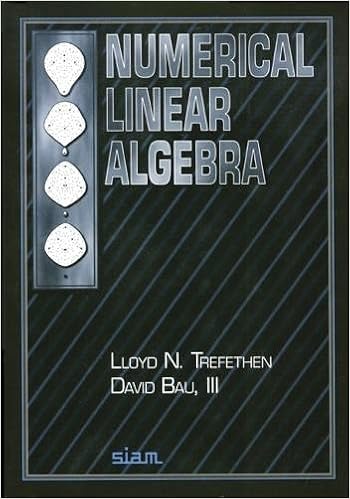
This is a concise, insightful introduction to the field of numerical linear algebra. The clarity and eloquence of the presentation make it popular with teachers and students alike. The text aims to expand the reader's view of the field and to present standard material in a novel way. All of the most important topics in the field are covered with a fresh perspective, including iterative methods for systems of equations and eigenvalue problems and the underlying principles of conditioning and stability. Presentation is in the form of 40 lectures, which each focus on one or two central ideas. The unity between topics is emphasized throughout, with no risk of getting lost in details and technicalities. The book breaks with tradition by beginning with the QR factorization - an important and fresh idea for students, and the thread that connects most of the algorithms of numerical linear algebra.
Your recently viewed items and featured recommendations
›
View or edit your browsing history
After viewing product detail pages, look here to find an easy way to navigate back to pages you are interested in.
Product details
Paperback: 184 pages
Publisher: SIAM: Society for Industrial and Applied Mathematics; 1 edition (June 1, 1997)
Language: English
ISBN-10: 0898713617
ISBN-13: 978-0898713619
Product Dimensions:
6 x 0.8 x 9 inches
Shipping Weight: 1.4 pounds (View shipping rates and policies)
Average Customer Review:
4.2 out of 5 stars
40 customer reviews
Amazon Best Sellers Rank:
#104,782 in Books (See Top 100 in Books)
This is without a doubt the most gentle treatment of not just algorithms and efficiency in numerical computations, but also the theory that allows these algorithms to work, and I really wish other books would follow suit. Too many books are more concerned with jamming ideas in your face over hundreds of topics because they fear becoming outdated in an ever expanding field (ESPECIALLY where linear algebra, or just vectors/data, is concerned).But this book has a clear purpose in mind. "This is a vector. A bunch of sorted data is a vector. This is how we need to handle it. This is how we're going to improve it. You can manipulate data like this, but not like that." And with that, you're left not just wanting more, but you're also fully prepared to tackle a more advanced text (like Iterative Methods for Sparse Linear Systems, an ideal "next step" from here. Or perhaps you're ready for linear programming/optimization methods? Or maybe even branching into nonlinear programming? Or convex analysis?). And you have the best foundation for being able to read through those jargon-heavy papers with giant summation signs and vector notation strewn everywhere without feeling "Oh, geez, another one of THESE papers."And this book, with all of its chapters and contents, is in no hurry to catch up with modern methods. It takes time to explain "Hey, look, we get that there are better ways of doing it. But the reasons those methods exist is because of what we're trying to show you."And the problems, wow! They're sorted into every possible category. You have your typical Simple - Challenging range, but you also have problems clearly designed for engineers with little abstract mathematical analysis ideas, problems clearly designed for computer scientists who have some knowledge but want something specifically applicable to them, problems clearly designed for the mathematician who can prove, and problems clearly designed for the mathematician who has more interest in application but needs more meat than the average engineer.And the presentation, wow! So much care is given to how much white space is needed between theorems, sections, equations, and algorithms. Trefethen and Bau know that math books, particularly numerical ones, tend to cram information too close together which can hurt the eyes.I'm absolutely gah-gah for this book. And you would be, too, if you sat down, read it, and worked through it. This is the second book I've ever had any desire to just sit down and try and work every problem through, and I'm almost done with it! And while there's only one book out there I frequently reread, this is one of the very books I keep coming back to when I need a quick reference while trying to sift through something like Bender's Decomposition or trying to construct a genetic algorithm.
This book is the best I have found for studying computational linear algebra. It is clearly written and well thought out. It might not be the best introduction to the subject, and something like Strang's Linear Algebra book is probably a better place to start out. The first few chapters are more of a review of an introductory linear algebra course, and assume that one has already seen standard topics like the definition of vector spaces, subspaces, spanning sets, linear independence, etc. However, for those who have taken a 1 quarter or semester course in linear algebra, this is the perfect place to go next.
Face it, most math textbooks are awful: boring to read, not much insight, little more than a compendium of definitions, theorems, proofs, and examples. Trefethen and Bau is an exception to that rule. Indeed, the field of numerical linear algebra is unusual in having available several top-notch textbooks: Golub and Van Loan, Stewart's two volumes, Saad's books on iterative methods, Demmel's introduction, Watkins' undergraduate level treatment, and T&B. All of these are excellent (and any student in numerical analysis should delve into all of them) but to my tastes T&B and Stewart are the standouts for insight and simply being fun to read.If you're a student using T&B in a course, to use it effectively you need to understand that T&B is a book to be read carefully for understanding; it's not a typical textbook suited only for "mining" for examples and solutions to homework problems. My students have sometimes complained -- accurately -- that T&B is short on details and worked examples, and many of the proofs are just sketches. But that's a feature, not a bug: you can learn much by filling in the missing steps. This is book for reading, so take the time to read it, to think about what you've read, and to fill in the gaps; it's worth it. If you need some worked examples, Watkins has them in great detail and would be a good supplement to T&B (though see the caveat below).The only minor gripe I have about T&B is that the order of topics (QR before LU before Cholesky) is unusual, which makes it a little awkward to coordinate with other books such as Watkins which do Cholesky before LU before QR.
I am a second year PhD student in Operations Research and for long I had been looking for a book in linear algebra to help me learn it myself (as I see that I need it no matter what research I want to do. It's just a good tool to know). One of my friends recommended this book to me, I got it and I am very happy with it. The book is great in different ways:-it is in the form of short lectures and for me who wants to learn linear algebra step by step, this is a perfect approach. You will have a 5-6 page lecture so whenever you start, you are set to finish that lecture.-It gives you intuition and understanding about what is really happenning geometrically which is amazing. To me, it is very important to have the "feeling" of what is happening because it is only then that you can think about bringing your real problem in this framework.-The examples in lectures clarify the subject while exercises give you a chance to learn even more.If you are new to linear algebra or know it but want to refresh your mind on intuitions and systematic thinking, I highly recommend this book.
Like this book a lot. I'm not a great mathematician so take this review with a grain of salt. But I had this book for a grad class and learned more computationally than I have in any other class.
Wonderful book, gives me a starting point for understanding most basic algorithms I come across as a user of linear algebra software.
Numerical Linear Algebra PDF
Numerical Linear Algebra EPub
Numerical Linear Algebra Doc
Numerical Linear Algebra iBooks
Numerical Linear Algebra rtf
Numerical Linear Algebra Mobipocket
Numerical Linear Algebra Kindle